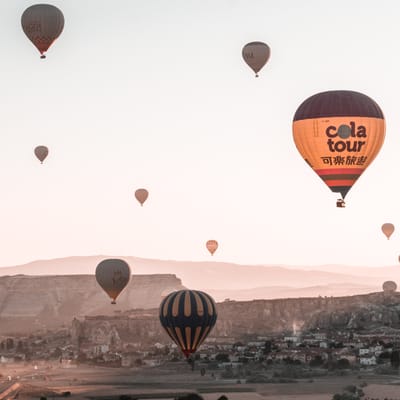
How Safe Are Cappadocia Balloon Rides? Safety Record & Regulations Explained
Quick Answer
Cappadocia balloon rides are regulated under Turkey's Directorate General of Civil Aviation (SHGM), which enforces strict balloon regulations, including mandatory commercial pilot licensing, equipment inspections, pre-flight checks before every launch, continuous weather monitoring, and compulsory passenger liability insurance carried by each licensed operator. We don't have an independently sourced, verifiable industry-wide accident-rate statistic to cite, so we won't quote one—but the regulatory framework applies to every licensed operator flying in the region.
Safety is the most common concern for first-time balloon passengers, and it is a completely valid question. You are stepping into a wicker basket suspended beneath a fabric envelope filled with hot air, rising hundreds of metres above the ground. It is natural to want reassurance. This article provides a thorough overview of Cappadocia's balloon safety framework, drawing on regulatory documents and publicly available safety information. For the full picture of what a Cappadocia balloon flight involves beyond safety, see our complete guide to Cappadocia balloon flights.
The SHGM: Turkey's Aviation Regulator
The Directorate General of Civil Aviation (Sivil Havacılık Genel Müdürlügü, or SHGM) is Turkey's equivalent of the FAA (United States) or EASA (European Union). The SHGM regulates all aspects of commercial balloon operations in Cappadocia, including operator licensing, pilot certification, equipment standards, weather minimums, and flight corridors.
What sets the SHGM apart from regulators in many other ballooning destinations is the level of specificity in its Cappadocia regulations. Because of the region's concentrated airspace (up to roughly 150 balloons operating simultaneously on a peak morning), the SHGM has developed Cappadocia-specific rules that go well beyond standard balloon aviation requirements.
Pilot Licensing Requirements
Cappadocia balloon pilots must meet some of the most rigorous qualification standards in the global balloon industry:
- •Commercial Balloon Pilot Licence (CBPL): Issued by the SHGM after completing a certified training programme, passing written examinations, and meeting the regulator's minimum flight-hour requirement.
- •Cappadocia Area Rating: An additional certification specific to flying in the Cappadocia region, requiring demonstrated knowledge of local terrain, wind patterns, emergency landing zones, and airspace procedures.
- •Annual medical examinations: All commercial pilots must pass a Class 2 aviation medical examination annually.
- •Recurrent training: Pilots must complete annual recurrent training and proficiency checks to maintain their licence.
- •Flight hour requirements: Many Cappadocia pilots build substantial flight-hour experience over their careers, though we don't have an independently sourced, verifiable industry comparison to cite.
The licensed operators we coordinate with are required by SHGM to hold a valid commercial balloon pilot licence; whether a given pilot also holds the specific Cappadocia area rating is confirmed per operator, not guaranteed uniformly in advance.
Equipment Inspection Protocols
Every balloon used for commercial flights in Cappadocia must meet strict equipment standards:
- 1.Annual Airworthiness Inspection: A comprehensive inspection conducted by SHGM-certified inspectors covering the envelope, basket, burner system, fuel tanks, instruments, and all rigging. The balloon must pass to continue commercial operations.
- 2.100-Hour Inspections: After every 100 flight hours, a detailed inspection of the burner system, fuel lines, and structural components is mandatory.
- 3.Pre-Flight Checks: Before every single flight, the pilot and ground crew perform a systematic pre-flight inspection covering envelope condition, burner function, fuel levels, basket integrity, instrumentation, and communication equipment.
- 4.Envelope Replacement: Balloon envelopes have a certified lifespan (typically 400–800 flight hours depending on the manufacturer). Operators must replace envelopes before exceeding their certified hours, regardless of visual condition.
The Weather Decision Process
Weather is the single biggest factor in balloon flight safety. The decision to fly or cancel follows a rigorous, multi-step process:
- 1.Evening assessment: Operators generally review weather forecasts for the following morning, including wind speed and direction, precipitation probability, and visibility forecasts.
- 2.Pre-dawn assessment: The SHGM reviews real-time meteorological data ahead of sunrise, including surface wind measurements and the latest available weather information.
- 3.Go/no-go decision: The SHGM issues a flight permit or cancellation order ahead of sunrise. This is a centralised decision — individual operators cannot override a cancellation order.
- 4.Launch site confirmation: Even after the SHGM grants permission, individual pilots conduct their own final assessment at the launch site. A pilot can cancel their own flight if they are not satisfied with conditions, even if the SHGM has given the green light.
Weather Minimums for Flight
- •Wind speed: SHGM guidance generally limits surface winds to around 10 knots (18.5 km/h), with winds at altitude capped near 20 knots.
- •Visibility: Minimum 5 km horizontal visibility.
- •Precipitation: No rain, snow, or thunderstorm activity within the flight area.
- •Cloud base: Must be above the maximum planned flight altitude.
Safety Statistics
While no form of aviation can claim to be 100% risk-free, Cappadocia's balloon safety record is excellent by global standards. Consider the following:
- •Ballooning is one of Cappadocia's largest tourism activities, believed to carry an estimated hundreds of thousands of passengers each year—though we don't have an independently sourced, verifiable exact figure to cite.
- •Serious incidents are widely described as rare in commercial ballooning — we don't have an independently sourced, verifiable Cappadocia-specific incident rate to cite, so we won't quote a precise figure.
- •When minor incidents do occur, they typically involve hard landings, which may result in bruises but rarely serious injury—though we don't have an independently sourced, verifiable breakdown of incident types to cite. Proper landing position (knees bent, holding rope handles) mitigates this risk.
Insurance Coverage
All licensed Cappadocia balloon operators are required to carry passenger insurance. On every flight Above Cappadocia coordinates, the assigned operator provides:
- •Mandatory aviation liability insurance: required under SHGM regulations, covering injury or death resulting from an aviation incident. Exact coverage terms are set by the operator's policy—ask us if you'd like the specifics for your assigned operator.
- •Third-party liability insurance: Covering damage to property or persons on the ground.
We also strongly recommend that all passengers carry their own comprehensive travel insurance that includes adventure activity coverage. This provides an additional layer of financial protection beyond the operator's mandatory coverage.
What Makes a Safe Operator?
Not all balloon operators are equal. When choosing a company, here is what to check:
| Factor | What to ask / check |
|---|---|
| SHGM licence | Verify the operator holds a current SHGM commercial balloon operating certificate. |
| Pilot experience | Ask about pilot qualifications and flight hours. Reputable operators are transparent about this. |
| Modern equipment | Ask when their balloons were last inspected and when envelopes were last replaced. |
| Basket capacity | Does the operator disclose passenger capacity per basket up front? |
| Insurance | Does the operator carry passenger liability insurance? Ask to see documentation if you want to confirm. |
| Safety briefings | A responsible operator conducts a thorough pre-flight safety briefing covering boarding, in-flight behaviour, and landing position—not just “hold on tight.” |
| Cancellation policy | How are refunds and rebooking handled for weather cancellations? Get this in writing before you pay. |
| Reviews | Check recent reviews on Google, TripAdvisor, and other platforms for mentions of safety and professionalism. Read our passenger reviews for real feedback. |
Common Safety Questions
Are Cappadocia balloon rides safe?
Cappadocia ballooning is backed by SHGM regulation, mandatory pilot licensing, daily weather assessments, and equipment inspections. No aviation activity is risk-free, but the regulatory framework here is strict and consistently enforced.
Can the balloon crash into another balloon?
Balloon-to-balloon contact is uncommon. Pilots coordinate via radio and use different altitude layers to maintain separation. When balloons do get close, they gently push each other apart—envelopes are flexible, not rigid. A balloon touching another balloon’s envelope is not dangerous; it is simply redirected.
What if the burner fails?
Balloons in Cappadocia typically carry dual independent burner systems as a safety redundancy—if one fails, the pilot can generally maintain control on the other and begin a controlled descent. The hot air already inside the envelope keeps the balloon aloft for several minutes even without additional heat, giving the pilot time to select a safe landing site.
What if the weather changes mid-flight?
Pilots monitor conditions throughout the flight. If wind picks up or visibility drops, the pilot initiates an early landing. The flight may be shorter than planned, but the priority is always a safe landing.
Is there a weight limit?
Each basket has a maximum payload determined by the balloon’s certification. Operators calculate total passenger weight before flight. There is no individual weight limit published, but passengers over 120 kg should inform the operator in advance so basket loading can be planned. For detailed health and accessibility information, see our health and accessibility guide.
Are children allowed?
Above Cappadocia does not accept children under 6 years old. Children must also generally be tall enough to see over the basket wall (approximately 1.2 meters), and an accompanying adult is required; exact height requirements are confirmed with your quote. For family-specific tips, see our families and kids guide.
Can the balloon catch fire?
The balloon envelope is made from rip-stop nylon treated with fire-resistant coatings. The burner flame is directed upward into the envelope opening and does not contact the fabric. Fire extinguishers are part of the standard pre-flight equipment check. Envelope fires are considered rare in modern ballooning.
Do I need to sign a waiver?
Yes. Passengers sign a standard flight waiver before boarding. This is common practice worldwide for aviation activities; waiver terms vary by operator and document, so review the specific wording for details on what it covers.
Safety Tips for Passengers
- 1.Listen to the safety briefing. It takes just a few minutes and covers everything you need to know, especially the correct landing position.
- 2.Wear appropriate footwear. Flat, closed-toe shoes with good grip. No heels, sandals, or flip-flops.
- 3.Secure loose items. Use a wrist strap for cameras and phones. Objects dropped from altitude are lost and can injure people on the ground.
- 4.Do not lean over the basket edge. The basket walls are designed to be at a safe height, but leaning over can change the basket's centre of gravity.
- 5.Follow the pilot's instructions immediately. Especially during landing, when the pilot may ask you to adopt the landing position (face direction of travel, knees bent, hands on rope handles).
- 6.Disclose medical conditions. Inform the operator of any relevant medical conditions, recent surgeries, or pregnancy when booking.
How Safety Decisions Are Made
For every flight we coordinate, safety is not a selling point — it is a non-negotiable foundation. The assigned operator's pilot has full authority to make independent weather decisions and can stand down a flight even when SHGM approval has been given, and Above Cappadocia will never pressure an operator to fly when their pilot has concerns.
Licensed operators are required to keep every balloon compliant with SHGM safety and maintenance requirements. Specific maintenance schedules and crew training records are held by the assigned operator and can be confirmed with them before booking.
For more on what to expect during your flight, see our minute-by-minute guide. Nervous about heights? Read our fear of heights guide. Ready to book? Reserve your spot or browse our flight options.
Related Articles
Cappadocia Balloon Drone Rules & Aerial Photography
Drones are banned during Cappadocia balloon flights. Learn the rules, fines, and how to get aerial-style shots without a drone from inside the basket.
Cappadocia Balloon Ride from Istanbul: Can You Do It as a Day Trip?
Cappadocia balloon ride from Istanbul as a day trip: flight schedules, costs from EUR 150, hour-by-hour plan, and whether one day is enough. Book with Above Cappadocia.
Cappadocia Balloon & Turkish Bath Spa Combo: 7 Best Post-Flight Pairings
Cappadocia balloon and Turkish bath spa combo: 7 ways to pair your sunrise flight with a hammam, massage, or spa. Recover in style from EUR 150 + EUR 30.