Cappadocia Hot Air Balloon Ride: What to Expect
Your alarm screams in the dark. For a moment, you question everything. Then you remember — today you fly over Cappadocia. Within hours, you'll be floating silently above a landscape that looks like it belongs on Mars, watching the sunrise paint fairy chimneys in shades of gold and rose. Here's a vivid walkthrough of what a flight morning can feel like, from that bleary-eyed wake-up call to the champagne toast in a farmer's field.
Key Takeaway
Quick answer: Your Cappadocia balloon day starts with an early hotel pickup, followed by a light snack with hot and cold drinks while you watch the balloons inflate. Takeoff is gentle and nearly imperceptible. The pilot varies altitude throughout the roughly 60-minute flight — from close passes over the valleys to higher panoramic views — depending on wind and airspace conditions on the day. You then land in a field for a champagne toast and flight certificate. The full pickup-to-return experience is approximately 3–4 hours. There is no fixed clock schedule: pickup, launch, and sunrise all shift with the season, and your assigned operator confirms your exact pick-up time the evening before, between 17:00 and 20:00.
The Pickup
A minivan arrives at your cave hotel. The driver greets you with a quiet "günaydın" (good morning) and hands you a bottle of water. The streets of Göreme are empty and dark, the fairy chimneys reduced to black silhouettes against a sky scattered with stars. You can feel the chill through the van window — even in summer, pre-dawn Cappadocia is cool, hovering around 12–15°C.
The van winds through narrow stone lanes, picking up other passengers from nearby hotels. Everyone is in the same state — half-asleep, cameras clutched in hands, buzzing with quiet excitement. The drive to the launch site is short, though the exact route and timing depend on your hotel's location and the operator assigned to your flight.
Arrival at the Launch Field
You step out of the van and the first thing that hits you is the sound — or rather, the absence of it. The launch field is a wide, flat clearing surrounded by fairy chimneys, and in the pre-dawn stillness, you can hear your own breathing. Before the flight, you're offered a light snack with hot and cold drinks while you watch the crews prepare — the hot tea is a welcome relief against the morning chill.
Scattered across the field, massive balloon envelopes lie flat on the ground like sleeping giants. Ground crews work methodically in the beam of headlights — connecting the basket to the envelope, checking cables, attaching burners, each step following a clear, practiced sequence.
The Inflation
This is the first truly magical moment. Industrial fans roar to life, blowing cold air into the envelope. The fabric ripples and billows, swelling from a flat heap into a massive dome. Then the pilot ignites the burners for the first time, and a column of orange flame shoots upward into the envelope with a thunderous WHOOOOSH that you feel in your chest.
The heat hits your face — a wave of warmth in the cold morning air. Inside the envelope, the air heats rapidly, and the balloon begins to rise from its side. Slowly, majestically, the enormous shape lifts upright, towering above you. The fabric glows from within, lit by the burner flame like a paper lantern. Across the field, dozens of other balloons are doing the same — a forest of glowing orbs rising out of the darkness. The sight draws involuntary gasps from many of those watching.
Boarding
Your pilot introduces themselves and delivers a brief safety briefing — how to brace for landing, where to hold, what the different signals mean. It's clear, concise, and reassuring. Then it's time to board. With help from the ground crew, you step up and swing your leg over the basket wall into your compartment; exact boarding height and any step assistance vary by operator and are confirmed with your booking. The wicker basket creaks as passengers settle in.
The basket is sturdier than you expected — reinforced wicker with padded edges and solid handholds. You're assigned to a compartment with a few other passengers. There's a brief moment of standing still, basket tugging gently against its tethers, and then —
Liftoff
The ground crew releases the ropes, and you rise. There's no jolt, no lurch, no dramatic moment of separation. The earth simply... recedes. It's so gentle that you might not notice until you glance down and see the ground crew shrinking below, their upturned faces catching the first light. The van you arrived in becomes a toy. The tea table becomes a dot.
The silence is extraordinary. Between burner blasts, the only sound is the whisper of air passing the basket and the distant barking of a farm dog. You're floating, weightless in a way that feels nothing like an airplane. There are no walls, no vibrations, no engine drone — just you, the basket, and an ocean of sky.
The Valley Crossing
The pilot may drop the balloon low, skimming the tops of fairy chimneys at what can feel like arm's reach. You can see the texture of the volcanic rock — layers of pink, white, and ochre compressed over millions of years. Pigeon holes carved into cliff faces flash past. A vineyard appears below, the vines planted in neat rows between cone-shaped rocks. You can smell the damp earth, the sage, the faint mineral tang of the tuff.
Then the pilot fires the burners and you rise again, climbing above the valley rim until the landscape unfolds beneath you in every direction — the impossible geometry of Cappadocia stretching to the horizon. Depending on the wind that morning, the view might take in Love Valley's pillars, Rose Valley's pink-hued canyons, or the neat cluster of Göreme's cave hotels; the exact route and which landmarks you pass changes with the wind and cannot be predicted in advance.
Sunrise
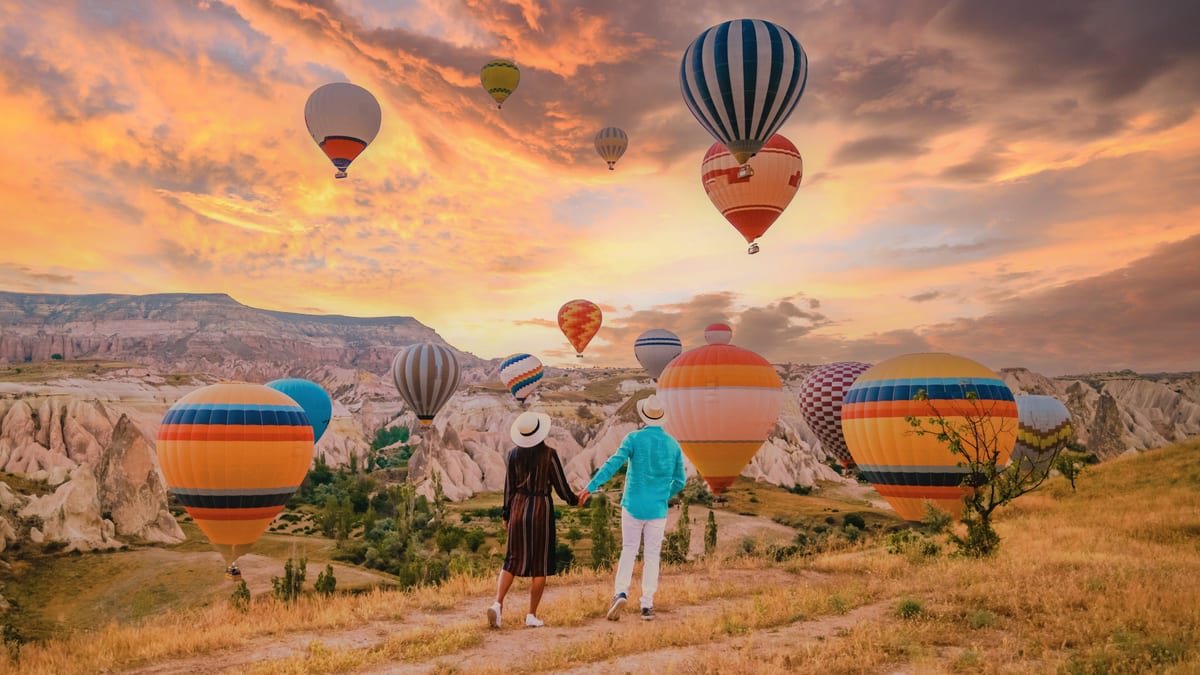
The eastern horizon begins to glow. First a thin line of amber, then peach, then gold, spreading across the sky like spilled paint. The moment the sun crests the mountains, everything changes. The fairy chimneys below you catch the light and turn from grey shadows to warm sandstone. The other balloons — there are many of them now, at every altitude and distance — ignite with color. Stripes of red, blue, yellow, and green pop against the golden sky.
This is the moment. The one you've seen in a thousand photographs, but no photograph prepares you for the scale of it — the sheer enormity of sky above, the ancient land below, the silent parade of balloons drifting through amber light. People around you go quiet. Some cry. Many reach for their camera, then lower it, because some moments need to be felt before they're captured.
The High Drift
The pilot may take the balloon toward the highest point of the flight — exactly how high depends on wind, airspace conditions, and the assigned operator's judgment on the day. From up here, Cappadocia reveals more of its full topography. On a clear morning, Mount Erciyes may be visible to the east, its snow-capped summit gleaming in the new sun. The patchwork of valleys, plateaus, and rock formations makes sense from up here — you can trace the ancient volcanic flows that created this landscape, see how water and wind sculpted the tuff into the shapes below.
The air at altitude is still and cold. Your breath makes small clouds. Pilots often point out landmarks along the way — perhaps the entrance to an underground city, a ribbon of road winding toward Uçhisar, or the glint of the Kızılırmak river in the distance, wind and route permitting. Other balloons drift at various levels around you, their passengers tiny figures leaning over basket edges.
Low-Level Flying
Many passengers call this part the most thrilling. When conditions allow, the pilot vents hot air and brings the balloon down into one of Cappadocia's narrow valleys. The rock walls can rise on either side, close enough in places to make out the texture of the tuff. Depending on the route the wind allows that morning, you may pass the dark openings of cave churches, hear a rooster crow from a farmhouse below, or catch the smell of wood smoke drifting up from a village kitchen — no two mornings follow quite the same path.
The pilot navigates using altitude changes to catch different wind currents — a few meters higher and the breeze pushes one way, a few meters lower and it pushes another. It's a dance with invisible forces, and a skilled pilot makes it look effortless. On some passes the balloon may come close enough to a fairy chimney to see the texture of the rough volcanic surface, while the pilot maintains a safe distance throughout.
The Descent Begins
The pilot radios the ground crew, who have been tracking your balloon by vehicle throughout the flight. They've identified a landing zone — usually a flat field or clearing. The balloon descends slowly, the landscape growing larger, details sharpening. You can see individual flowers in the fields below, the texture of stone walls, a shepherd leading goats along a dusty path.
The pilot calls out for landing positions. You turn to face the direction of travel, bend your knees slightly, and grip the rope handles inside the basket. There's a brief flutter of anticipation — and then the basket touches down with a gentle bump. Sometimes it skids a few meters; sometimes it's perfectly still. The ground crew rushes in, grabbing ropes and stabilizing the basket. You've landed.
The Champagne Celebration
The ground crew helps you climb out of the basket, and the pilot pops open a bottle of champagne — a satisfying pop that echoes across the empty field — and pours a glass for everyone. This toast is a long-standing ballooning tradition.
You raise your glass, clink with strangers who now feel like friends, and drink in the cool morning air. A commemorative flight certificate signed by your pilot is handed out with your name and the date — a tangible memento of what already feels like a dream. Some passengers hug. Others stand quietly, looking back at the sky where a few late balloons are still drifting.
The Return
The van takes you back to your hotel through a Cappadocia that's now fully awake — shops opening, the smell of fresh bread from bakeries, the call to prayer floating from a minaret. You're back at your cave hotel in time for a full Turkish breakfast on the terrace, generally within the overall 3–4 hour pickup-to-return window. As you spread honey over fresh bread and sip your tea, you can see the last balloons landing in the distance.
The rest of the day stretches ahead of you, and Cappadocia has plenty more to offer. But you already know that the hour you spent floating above the fairy chimneys will be the memory you carry longest. It's the kind of experience that rearranges your sense of what's possible — quiet, vast, and utterly unforgettable.
Prepare for Your Flight
Now that you know what to expect, it's time to prepare. Read our guide on what to wear on your balloon ride and check out our first-timer tips for practical advice on cameras, clothing, and making the most of every minute. Ready to book? Explore the flight details — the Cappadocia Sunrise Balloon Flight includes hotel pick-up and drop-off, a light snack with hot and cold drinks, the approximately 60-minute flight itself, a champagne celebration after landing, and a pilot-signed flight certificate.
Related Articles
Cappadocia Balloon Ride Cancelled? 12 Amazing Things to Do Instead
Bad weather grounded the balloons? Don't worry — Cappadocia has so much more to offer. Here are 12 incredible alternatives for your day.
Planning a Cappadocia Balloon Proposal
How to plan a Cappadocia balloon flight proposal: timing, valleys, ring safety, and what to expect from the flight.
How Hot Air Balloons Work + Cappadocia Ballooning History
The science behind hot air balloon flight, 30+ years of Cappadocia ballooning history, and why this region became the world's top balloon destination.